Monday, April 27, 2015

Government Ethics with respect to Social Media


The following is from this website:

http://oge.gov/uploadedFiles/OGE_Advisories/Legal_Advisories/OGE.Social.Media.LA.15.03%20%284.9.15%29.pdf

April 9, 2015 
LA-15-03 
LEGAL ADVISORY 
TO: Designated Agency Ethics Officials 
FROM: David J. Apol 
General Counsel 
SUBJECT: The Standards of Conduct as Applied to Personal Social Media Use 
Use of social media has become prevalent among Federal executive branch employees and agencies. The U.S. Office of Government Ethics (OGE) is aware that agency ethics officials have an interest in understanding how the Standards of Ethical Conduct for Executive Branch Employees (Standards of Conduct), 5 C.F.R. part 2635, apply to the use of social media. This interest is reflected in the increased volume of questions that OGE receives from various agencies seeking advice in this area. 
As an initial matter, the Standards of Conduct do not prohibit executive branch employees from establishing and maintaining personal social media accounts. As in any other context, however, employees must ensure that their social media activities comply with the Standards of Conduct and other applicable laws, including agency supplemental regulations and agency-specific policies. To assist employees and agency ethics officials in this endeavor, OGE is providing the following guidance regarding issues that agency ethics official have frequently raised concerning employees’ obligations under the Standards of Conduct when using social media.1
1 Employees should remain aware that other statutes and regulations outside of OGE’s purview may further limit their use of social media. For example, the Hatch Act, 5 U.S.C. § 7321, et seq., limits the extent to which executive branch employees may use social media to engage in certain political activities. See U.S. Office of Special Counsel, Frequently Asked Questions Regarding the Hatch Act and Social Media, April 4, 2012, available at: https://osc.gov/Resources/Social%20Media%20and%20the%20Hatch%20Act%202012.pdf 
1.Use of Government Time and Property

When employees are on-duty, the Standards of Conduct require that they use official time in an honest effort to perform official duties. See 5 C.F.R. § 2635.705. As a general matter, this requirement limits the extent to which employees may access and use their personal social media 2 

accounts while on duty. The Standards of Conduct also require employees to protect and conserve government property and to use government property only to perform official duties, unless they are authorized to use government property for other purposes. See 5 C.F.R. §2635.704. For example, under the Standards of Conduct, a supervisor may not order, or evenask, a subordinate to work on the supervisor’s personal social media account. Coercing or inducing a subordinate to maintain the supervisor’s personal account would amount to a misuse of position and, if done on official time, a misuse of official time. The same would be true if the supervisor were to have a subordinate create content for the supervisor’s personal account, even if the subordinate were not involved in uploading the content to that account. 5 C.F.R. §§ 2635.702(a), 2635.705(b). 
Where agencies have established policies permitting limited personal use of government resources by their employees, those policies control what constitutes an authorized use of government resources. See, e.g. OGE Informal Advisory Opinion 97 x 3. In some cases, such “limited use” policies may authorize employees to access their personal social media accounts while on duty. 
2.Reference to Government Title or Position & Appearance of OfficialSanction

A question that frequently arises is the extent to which employees may reference their official titles on their personal social media accounts. In general, the Standards of Conduct prohibit employees from using their official titles, positions, or any authority associated with their public offices for private gain. 5 C.F.R. § 2635.702. The Standards of Conduct also require that employees avoid using their titles or positions in any manner that would create an appearance that the Government sanctions or endorses their activities or those of another. 5 C.F.R. §§ 2635.702; 2635.807(b).2
2 Agency supplemental regulations may place further limitations on employees’ use of title or position, or may impose additional requirements such as mandating the use of a disclaimer. 
Employees’ use of personal social media ordinarily will not create the impermissible appearance of governmental sanction or endorsement which would be prohibited under §2635.702(b). An employee does not, for example, create the appearance of governmentsanction merely by identifying his or her official title or position in an area of the personal social media account designated for biographical information. See e.g. OGE Legal Advisory LA-14-08; OGE Informal Advisory Opinion 10 x 1. 
In evaluating whether a reference to an employee’s official title or position on social media violates the Standards of Conduct, the agency ethics official must consider the totality of the circumstances to determine whether a reasonable person with knowledge of the relevant facts would conclude that the government sanctions or endorses the communication. See, e.g. 5 C.F.R. §§ 2635.702(b); 2635.807(b); OGE Legal Advisory LA-14-08; OGE Informal Advisory Opinion 10 x 1. Relevant factors for agency ethics officials to consider in making the determination include: 3 


Whether the employee states that he or she is acting on behalf of thegovernment;

Whether the employee refers to his or her connection to the government assupport for the employee’s statements;

Whether the employee prominently features his or her agency’s name,seal, uniform or similar items on the employee’s social media account orin connection with specific social media activities;

Whether the employee refers to his or her government employment, title,or position in areas other than those designated for biographicalinformation;

Whether the employee holds a highly visible position in the Government,such as a senior or political position, or is authorized to speak for theGovernment as part of the employee’s official duties;

Whether other circumstances would lead a reasonable person to concludethat the government sanctions or endorses the employees’ social mediaactivities; or

Whether other circumstances would lead a reasonable person to concludethat the government does not sanction or endorse the employees’ socialmedia activities.

Ordinarily, an employee is not required to post a disclaimer disavowing government sanction or endorsement on the employee’s personal social media account. Where confusion or doubt is likely to arise regarding the personal nature of social media activities, employees are encouraged to include a disclaimer clarifying that their social media communications reflect only their personal views and do not necessarily represent the views of their agency or the United States. A clear and conspicuous disclaimer will usually be sufficient to dispel any confusion that arises. See OGE Legal Advisory LA-14-08. 
3.Recommending and Endorsing Others on Social Media

Social media networks, particularly those focused on job seeking, sometimes allow users to recommend or endorse the skills of other users. The Standards of Conduct permit employees to use social media to make such recommendations or endorsements in their personal capacity. It is not a misuse of position for employees to provide such endorsements merely because they have provided their official titles or positions in areas of their personal social media accounts that are designated for biographical information. 
OGE is aware that at least one social media service automatically adds a user’s name, title, and employer to any recommendation that the user posts regarding a job seeker. In any such case where title and employer name are added automatically, OGE does not consider a 4 

recommendation to constitute a misuse of position because the recommendation is readily understood by users of the social media service to be personal, rather than official, in nature. An employee should not, however, affirmatively choose to include a reference to the employee’s title, position, or employer in a recommendation, except where 5 C.F.R. § 2635.702(b) expressly permits such references. 
4.Seeking Employment Through Social Media

The basic provisions governing seeking employment are set out in subpart F of the Standards of Conduct. For these purposes “seeking employment” includes not only the kinds of bilateral employment negotiations that would implicate 18 U.S.C. § 208, but also certain unilateral expressions of interest in employment by the employee. Specifically, in addition to actual negotiations, as described in section 2635.603(b)(1)(i), seeking employment also includes unsolicited communications by the employee regarding possible employment, as described in section 2635.603(b)(1)(ii), and any response by the employee, other than rejection, to an unsolicited overture from a prospective employer, as described in section 2635.603(b)(1)(iii). See OGE Informal Advisory Opinion 04 x 13. 
Employees who are seeking or negotiating for employment through social media must comply with the applicable disqualification requirements of 5 C.F.R. § 2635.601, et seq., 18 U.S.C. § 208, and any additional requirements found in agency supplemental regulations. Public financial disclosure filers who are negotiating or have an arrangement concerning future employment or compensation also must comply with the notification requirements found in section 17 of the Stop Trading on Congressional Knowledge Act of 2012. See 5 U.S.C. app. §101, note; OGE Legal Advisories LA-13-06 and LA-12-01.
An employee is not considered to be seeking employment with any person or organization merely because the employee has posted a resume or similar summary of professional experience to the employee’s personal social media account. Likewise, an employee is not considered to be seeking employment merely because a person or organization has viewed the employee’s resume on that social media account or has sent an unsolicited message, including one containing a job offer, to the employee. An employee who receives an unsolicited message or job offer is seeking employment with the sender only if the employee responds to the message and the employee’s response is anything other than a rejection. 5 C.F.R. § 2635.603. 
An employee will be considered to be seeking employment with a person or an organization if the employee contacts that person or organization concerning future employment. In the age of social media, there are a multitude of ways that an employee might contact a prospective employer and thereby trigger the seeking employment rules. For example, an employee would trigger the seeking employment rules by sending a message directly to the organization, uploading a resume or application to the prospective employer’s social media account for recruiting employees, or otherwise targeting the organization through a social media communication. 5 


5.Disclosing Nonpublic Information

The Standards of Conduct prohibit employees from disclosing nonpublic information to further their private interests or the private interests of others. See 5 C.F.R. § 2635.703. This prohibition applies without regard to the medium used for the unauthorized disclosure. In addition to the Standards of Conduct, other statutes and regulations prohibit the disclosure of specific categories of nonpublic information, such as classified or confidential information. Employees must follow the rules regarding the disclosure of nonpublic information found in the Standards of Conduct and all other applicable rules when using social media. The Standards of Conduct generally do not prevent employees from discussing or sharing government information that is publicly available. Employees may not, however, accept compensation for statements or communications made over social media that relate to their official duties. See 5 C.F.R. §§ 2635.807(a); 2635.703. 
6.Personal Fundraising

Employees may use personal social media accounts to fundraise for nonprofit charitable organizations in a personal capacity, but they must comply with 5 C.F.R. § 2635.808, the section of the Standards of Conduct that covers fundraising. As a general rule, fundraising solicitations over social media are permissible so long as the employee does not “personally solicit” funds from a subordinate or a known prohibited source. See 5 C.F.R. § 2635.808(c)(1). 
Fundraising requests over social media are potentially visible to a wide audience of followers and connections. An employee who posts or publishes a general fundraising announcement or request over social media has not “personally solicited” any prohibited source or subordinate merely because the employee is connected with the prohibited source or subordinate through the social media network. The same is true even if the prohibited source or subordinate views, comments on, or responds to the post. However, an employee may not respond to inquiries posted by prohibited sources or subordinates in reference to the fundraising request. Furthermore, an employee may not specifically reference, link to, or otherwise target a subordinate or known prohibited source when fundraising over social media. An employee doing so will be considered to have “personally solicited” that person in violation of 5 C.F.R. §2635.808(c)(1). See OGE Informal Advisory Opinion 93 x 19; OGE Informal AdvisoryOpinion 93 x 8. 
Additionally, employees may not use their official titles, positions, or authority associated with their positions to further fundraising efforts. See 5 C.F.R. § 2635.808(c)(2); OGE Informal Advisory Opinion 96 x 2. Employees are not considered to have used their official titles, positions, or authority associated with their positions to further fundraising efforts merely because they have provided this information in areas of their personal social media accounts designated for biographical information. 
7.Official Social Media Accounts

Many Federal agencies maintain one or more official social media accounts for use in conducting official business. Subject to applicable legal authorities, each agency determines the 6 

purposes for which its official accounts may be used. See, e.g. OGE Informal Advisory Opinions 93 x 6 and 93 x 24. When employees use these official accounts, they must do so in accordance with applicable agency directives, regulations, and policies. See 5 C.F.R. § 2635.704(a); OGE Informal Advisory Opinion 97 x 3. Put simply, official accounts are for official purposes. 
OGE encourages agencies to adopt policies indicating which employees are authorized to access official accounts and defining the authorized uses for those accounts. Agency officials responsible for social media accounts may wish to visit the General Services Administration’s online Federal Social Media Community of Practice and Social Media Registry at http://www.digitalgov.gov/. 
Additional Information 
In light of the ever evolving nature of social media, the foregoing advice is not intended to be comprehensive. OGE expects to issue additional guidance in the future addressing questions outside the scope of this Legal Advisory. Designated Agency Ethics Officials with questions regarding the application of the Standards of Conduct to social media may contact their assigned OGE Desk Officers.

Monday, April 20, 2015

Safety, without the verbage


"We actively care about the safety of ourselves, one another, and the public. Success is safely achieving our mission--with all of us returning home every day."

This is the saying within the USDA Forest Service Safety group. I'm a little uncertain if this is a mission statement, guiding principle, or perhaps a parable for the Forest Service employees.

So. That seems to be a little wordy, and redundant, saying something with a few too many words.

Let's start with the first three words. "We actively care". Is not care an active verb already? ​Could the sentence start simply "We care"?

Now, skip over a few words and let's think about the phrases "ourselves, one another, and the public". Am I missing something? This seems to cover a one word term--everybody. Could the number of people cared for just be rolled into one word?

The first sentence could then be reduced, with no loss of meaning to "We care about the safety of everyone". Not cumbersome. Not convoluted. Just the facts.

The second sentence: "Success is safely achieving our mission--with all of us returning home every day". The question becomes what happens if somebody doesn't return home some day? Has the success of the mission failed? What if they spend the night out in the woods, camping? Or they are at a conference and spend the night in a motel? Has the success of the mission been compromised? I don't think so.

What if the second sentence was truncated to: "Success is safely achieving our mission". It doesn't matter where the person spends the night. The mission is deemed successful if it is accomplished safely, regardless of where the person spends the night.

Here's the complete safety message,, but reduced of superfluous, redundant, unnecessary verbiage:

"We care about the safety of everyone. Success is safely achieving our mission"

Friday, June 20, 2014

Why I love wild lands


I thought I wrote a poem about why I love wilderness, but this is what the USDA Forest Service posted on one of their websites:
The beauty of the canyon, the vastness of bluebunch wheatgrass waving in the wind, the wild ungulate on the hillside, are just some of the wonders that cause me to love wilderness. The snake in the grass, the innumerable rocks just waiting to twist my ankle
the poison ivy along the river trail, the exposed ridges during a summer lightning storm. The jewel that is every flower, the blue sky waiting for the change in weather, the ancestors who walked here before are more of the wonders that I love about our wildernesses.

Hell's Canyon near Deep Creek
And this is what I wrote with the proper formatting:
Why I love Hell's Canyon Wilderness:

The beauty of the canyon,
The vastness of bluebunch wheatgrass waving in the wind,
The wild ungulate on the hillside,
Are just some of the wonders that cause me to love wilderness.

The snake in the grass,
The innumerable rocks just waiting to twist my ankle
The poison ivy along the river trail,
The exposed ridges during a summer lightning storm.

The jewel that is every flower,
The blue sky waiting for the change in weather,
The ancestors who walked here before
Are more of the wonders that I love about our wildernesses.

I suppose it's no big deal. Although I do prefer the way I wrote it over the way the FS published it. Maybe it is just a little quibble.

Wednesday, March 26, 2014

If English Were Made Official

From a letter to the editor of the Oregonian, sometime ten or fifteen years ago:


To the Editor:

If America is to get with the programme, we need to make English the official language. Nearly all the other former colonies of Britain have honoured her by designating English as the offcial language of usage.

Soon we may be able to motor our lorries to the panel beater, who can check under the boot for a spare tyre, wash the wind screen and check the oil under the bonnet. Whilst the mechanic is under the bonnet we can use the hooter to frighten him.

If we started using English as the official language, would we make as much noise switching to metric as the Brits are making now, or would we use the traditional English measurements? Officially, you may weigh 11 stones and drive 4 leagues to work. And remember there are 12 pennies to the shilling.

If English were declared the official language, which foreign words would be chic to use and which would be verboten?

If you insisted on going to the bathroom instead of the loo or the water closet you might be sent to prison. For such a hideous crime you probably would not want to be in gaol.

Wednesday, February 19, 2014

The People of the Bush

Boteti sub-district of the Central District of Botswana was a dry, dusty, out of the way place in 1989. With no paved road, no telephones, no electricity, and a six hour drive to the capitol, Gaborone, it was about as remote of a post as one can imagine. The area was sandy, covered with grass in the west, and short, shrubby types of trees in the east part of the district.

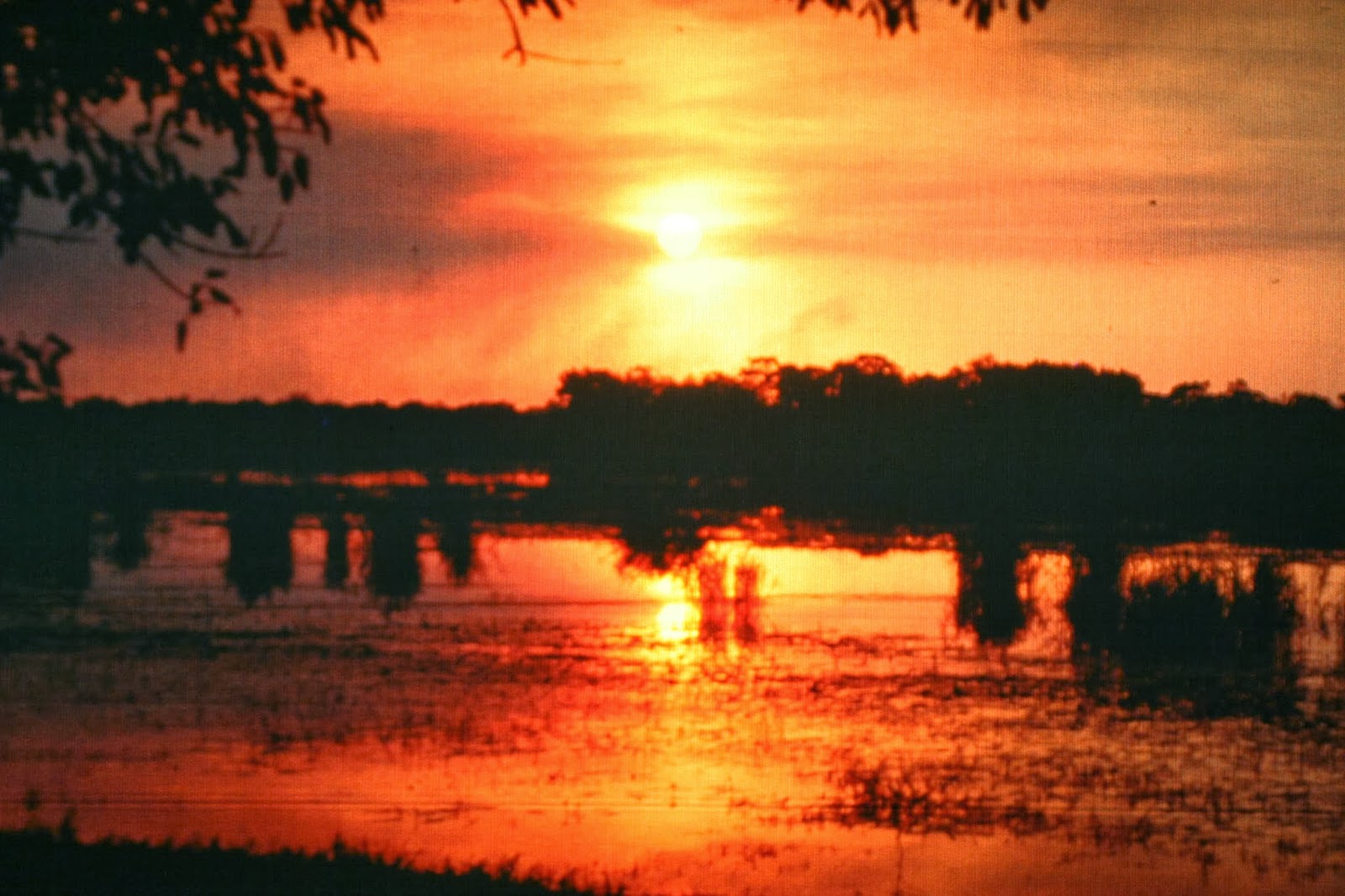
One of many magnificent sunsets in Botswana, 1989.
It was here that an American couple were living, she working for the Ministry of Lands as a Drought Relief Technical Officer, in other words, working in community development, and he was a Forestry Officer for the Ministry of Agriculture. They had lived in Letlhakane for a year, and were planning to stay for another year.

The Forestry Officer decided to take a trip to the western villages of the district to view the successes of the recently held National Tree Planting Day. In addition, he was going to inquire as to the need for more trees as well as check on the progress of three village woodlots. Usually, he travelled with a driver who was assigned to his office. There were three or four drivers: Palagabedi, Onkagatsi, Benjamin and Seepeto, but at this time they were all busy. The Forestry Officer was going to have to go it alone.

For several days he travelled west from the populated villages and diamond mining town to the vast open, dotted with tiny settlements along the dry Boteti riverbed. He wanted to get back home on Thursday, and he was hoping that he could do it before it got dark.

Traveling at night could be a terrifying experience in Botswana. There were the ever present bovines, that would wander across the road, or simply decide to stand in the middle of the road for the duration of the night. Then there was the wildlife--ostriches, impala, kudu, that would think nothing of being in the road, without any reflective gear. There were also other drivers. Several stories were told of somebody's vehicle breaking down on the road, and the driver would turn off the lights, not wanting the battery to die, and walk to the nearest village for assistance. Never would the thought occur to someone to pull off of the road.

The Forestry Officer got a late start from Makalamabedi, and after stopping in Motlopi once again, he realized he was running late. He travelled as fast as the sand track would allow him to drive the Toyota Hi-lux pick-up, and as he approached Rakops, he could see a spectacular African sunset happening. He had several hours to go before he returned home.

At the far end of the village of Rakops was a place people would wait to hitch a ride east. In Botswana at this time, in the "bush," it was common courtesy to give people rides who needed them. Private vehicles were infrequent, and public transportation, buses, taxis, were non-existent. There were thirteen people at the hitching spot.

He glanced in his rear view mirror and saw nobody behind him. No surprise. But he did glimpse the continuing spectacular sunset. Thinking that all of the thirteen people weren't waiting for a ride, that maybe some of them were merely waiting to say goodbye to their friends and relatives, he pulled over and after the appropriate greetings asked, "O ya kae?" Where are you going?

The monna magolo, the old man, said they were going to Orapa, and they all wanted a ride. "A re ye," said the Forestry Officer, we go. The women and children started loading their meager belongings into the bed of the small pick-up, and followed their gear into the open back. The old man, and a young twenty something man got into the cab with the driver. Just to be sure he had heard what he thought he heard, he asked the two in the cab with him where they were going, and they again replied Orapa.

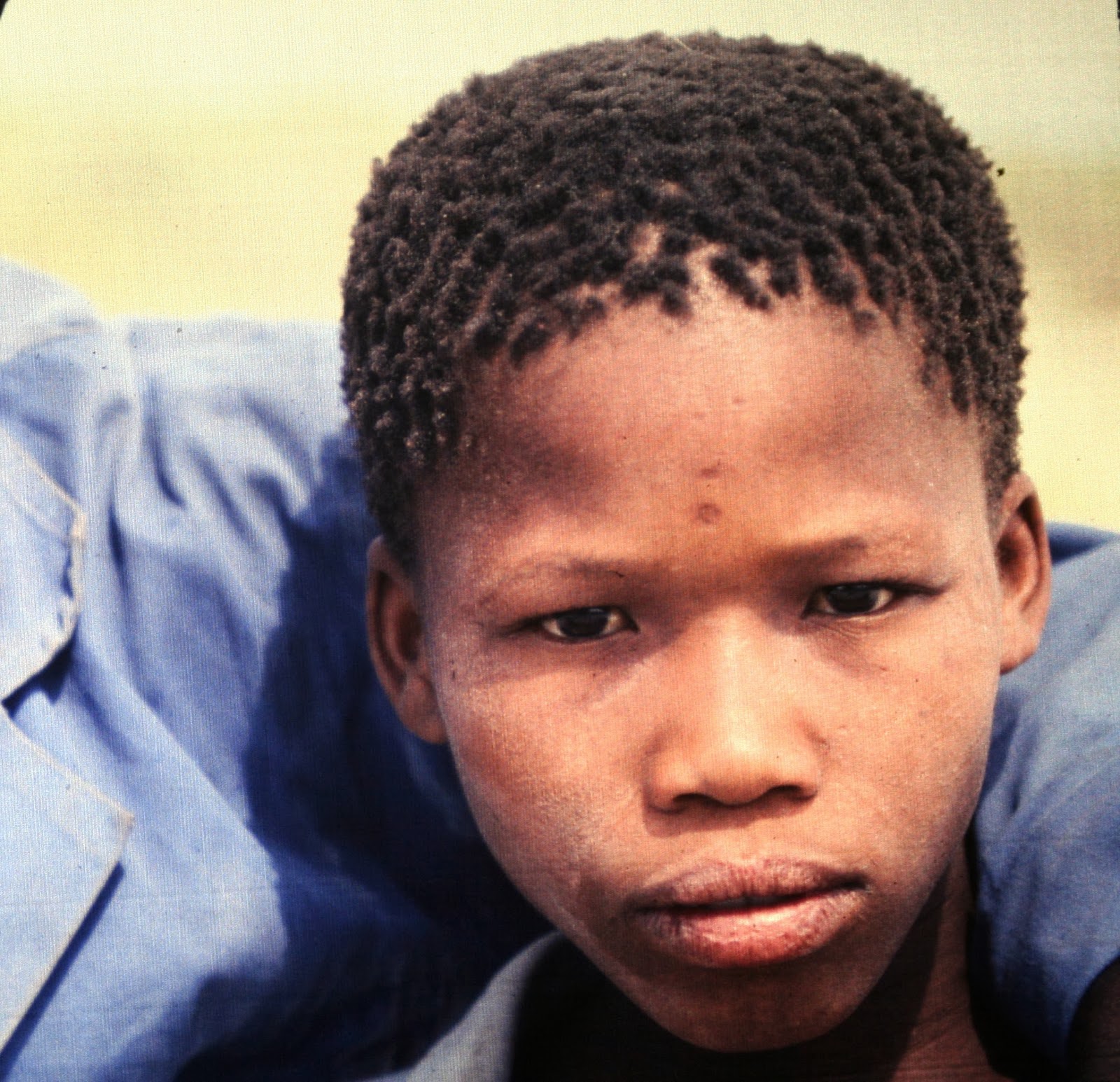
A San youngster, Botswana, 1989.
Orapa is a diamond mining town about thirty kilometers northwest of Letlhakane. It is a closed community, with a fence around the area of ten by twenty kilometers. There are guards at the gates and if one doesn't have a good reason for going to Orapa, the guards will turn you away. This group of hitch hikers did not look like they had any reason to go into the town.

Just after they started picking up speed there was a knock on the back panel of the pick-up. Somebody back there wanted to stop. The old man asked the Forestry Officer to stop, and because there was seldom anyone driving these primitive roads, he stopped in the middle of the road. A women in the back jumped out, ran to a nearby rondoval, the traditional circular mud hut with thatched roof, and was quickly returning with a blanket. The driver glance in his rear view mirror to make sure she was settled in, and then focused on the blazing sunset.

Again they were underway, and shortly there was another knock from the back. The driver was becoming a little frustrated. He wanted to make some good distance while it was still light, but with every stop, the seconds, the minutes, where passing quickly, and he would soon be driving in the dark. Once the vehicle stopped, he watched a woman jump out of the back and run down the road. The driver watched, puzzled by her running along the road, but awed by the continuing sunset. Sunsets in Botswana seemed to be more vibrant, longer lasting, larger, than the sunsets he was use to in the United States. The woman picked up some fabric, a scarf, that must have blown off of her head,

Sunset in the Okavango Delta of northern Botswana.
They were off again, zooming along at 60 kilometers an hour. The two passengers were discussing something in a language the driver didn't understand, but he got the impression they were talking about the speedometer.

A short time later, the old man started fishing around in his oversized, well-worn pants. He pulled out a fist-sized amount of crumpled newspaper and opens it up on his lap. He tears off a corner of paper and then sprinkles some of the dried herbs that had been in the paper onto the smaller piece and rolls it into a cigarette. About this time the driver pushes in the cigarette lighter. The old man was fishing in his pockets for matches when the cigarette lighter pops out and the driver hands it to the old man. After the cigarette is lit, there is quite the discussion about the lighter, and the old man pushes the lighter in several times to witness for himself the miracle of fire on the truck.

By the junction of the road to Toromoja, the sky was darkening. The brilliant sunset was fading to dark.  It was becoming harder to see anything outside the headlight beam, and the truck was slowed to about 40 kilometers. By the time they reached Mopipi, it was pitch black.

There was a knock from the back and the driver stopped in downtown Mopipi, population 200. Several women climbed out of the back of the truck along with a child, leaving seven passengers in the back, along with the two men in the cab with the driver.

At the edge of the village there was another knock. The driver thought, what is going on with these people? Couldn't somebody have walked the half kilometer to here? Some of the women in the back got out and squatted. The two passengers in the cab got out, and standing in front of the pick-up, urinated into the headlight beams. Everyone got back into the vehicle and the old man said, "Tsamaya." Go.

It was going to be another hour, at least, to home in Letlhakane, but the road was straight and flat the entire way. The vegetation consisted entirely of mophane, a shrub in the legume family; definately a monoculture of shrubs. The mophane was densely spaced, and uniformly three to four meters tall. In the dark it looked very homogenous. There would be Orapa to deal with, but none of it's lights were visible when there was another knock from the back.

Argh!

How many stops are they going to make, thought the driver, now thoroughly frustrated. The women and children in the back were getting out, handing their bags out one at a time. The young man and the old man in the cab both slid out and closed the door behind them. Everyone was getting out of the vehicle. Suddenly, the old man was next to the driver's side door, and through the open window clasps his hands, bows slightly, and says, "Danki, rra." Thank you, sir.

In the dark, all of his riders stepped into the bush and quickly disappeared. The Forestry Officer got out of the vehicle and peered into the darkness. He reached into the cab and turned the engine off, then the headlights. It was dark and quiet. His nine passengers had disappeared, quietly into the dark, all nine of them. They knew where they were going--home. He looked up and down the road. It appeared just like the other hundred kilometers before and after the stop. No signs. No lights. Nothing that he recognized would indicate that this was a place to stop to let somebody head home. And there were nine people, women, children and an old man walking in the dark to some shelter somewhere.

As the Peace Corps Volunteer stood there in the dark, he tried to ponder the meaning of life. He looked up to the stars spread out from horizon to zenith and into infinity; he looked into the bush, up and down the darkened road; and thought he lived in an awesome place.

The slow drive into Letlhakane was somewhat of a denouement of the final part of his trip to west Boteti. It was good to see his spouse and catch up with all the news, but something was rattling around in his mind--who were they? What were they doing? Where were they going? Are they doing okay? What became of them? How did they know where to go?

They were questions he continues to find the answers to.


Monday, February 10, 2014

Skiing on Mount Emily

A video of a recent ski off of the ridgetop on the Mount Emily Recreation Area in northeast Oregon:


http://www.youtube.com/watch?v=qb3NERPP8Xs&list=UU9APyQYJnUbgH5887kBLiPQ&feature=c4-overview&noredirect=1

Cheers.

Friday, January 24, 2014

Happy Birthday, George Washington Carver!

He could have added fortune to fame, but caring for neither, he found happiness and honor in being helpful to the world.--Inscription from the gravestone of George Washington Carver

In 1964, his family had just moved from the big city to a small town in western Colorado. The town library was a very small fraction of the size of the big city library. His junior high school library was in an almost closet sized room off of the office of the principal.

He liked reading all sorts of books, but his favorites seemed to be biographies of inventors and other scientists. He had read books on Galileo, and Edison, and Einstein. So while he was perusing the small library in his small school in the small western Colorado town he noticed one book with the label on the spine that said, "George Washington Carver." He pulled it off the shelf and casually flipped through it, then, while replacing the book back on the shelf, wondered--who would name their child after a President of the United States?

A few weeks later, he checked out the biography of George Washington Carver. It turned out that there was more than scientific discoveries in the book. There was philosophy and words to live by:

"It is not the style of clothes one wears, neither the kind of automobiles one drives, nor the amount of money one has in the bank, that counts. These mean nothing. It is simply service that measures success." -- George Washington Carver

From: http://uspsstamps.tumblr.com/post/27049602788/happy-birthday-george-washington-carver-born-on
Years later he and his spouse, on a road trip across the United States, stopped in Diamond, Missouri and visited the birthplace of Carver.

Carver was born to a slave named Mary in the month of January, 1864. That's all that is known.  Mary had no known last name, and she was owned by a couple named Carver. As George was growing up he would introduce himself as "Carver's George." George Washington Carver was able to overcome numerous hardships, and racism that was prevalent throughout the US during his life.

George Washington Carver went on to study in Kansas and Iowa, and then became a professor at Tuskegee Institute in Alabama. Carter is famously known for developing over 100 new products from the peanut plant. With a greater need for peanuts, farmers were then encouraged to rotate their crops, from a continuous growing of cotton, to every other year planting peanuts, allowing the soil to rest and providing nitrogen to the depleted soils.

Carter also worked on sweet potatoes, cowpeas, soybeans, and other crops developing dyes, paints, lubricants, mayonnaise, and other products.

There is a sense felt that Carver was to the early twentieth century what Nelson Mandela became in the late twentieth century. Maybe this is hyperbole. Maybe. But the obstacles, the resistance, the hardships that he faced throughout his life failed to create fear and hate in his heart.

"One of the things that has helped me as much as any other, is not how long I am going to live but how much I can do while living." -- George Washington Carver

George Washington Carver did not let the haters spoil his life. He rose above those feelings to achieve things which benefited all of humankind. And now the young boy who moved to that small town in western Colorado years ago, has grown and tried, sometimes not very well, to live as Carver had lived. Are there heros in your life? Are there people in your life who overcome all hurdles to rise above the fray?

A few more quotes by George Washington Carver:

"Day after day, I spent in the woods alone in order to collect my floral beauties, and put them in my little garden I had hidden in brush not far from the house, as it was considered foolishness in the neighborhood to waste time on flowers." -- George Washington Carver

"One reason I never patent my products is that if I did it would take so much time, I would get nothing else done. But mainly I don't want my discoveries to benefit specific favored persons." -- George Washington Carver

From: http://www.biography.com/people/george-washington-carver-9240299
"Ninety-nine percent of the failures come from people who have a habit of making excuses." -- George Washington Carver

"Nothing is more beautiful than the loveliness of the woods before sunrise." -- George Washington Carver

Happy birthday, George! You still rise above the rest.