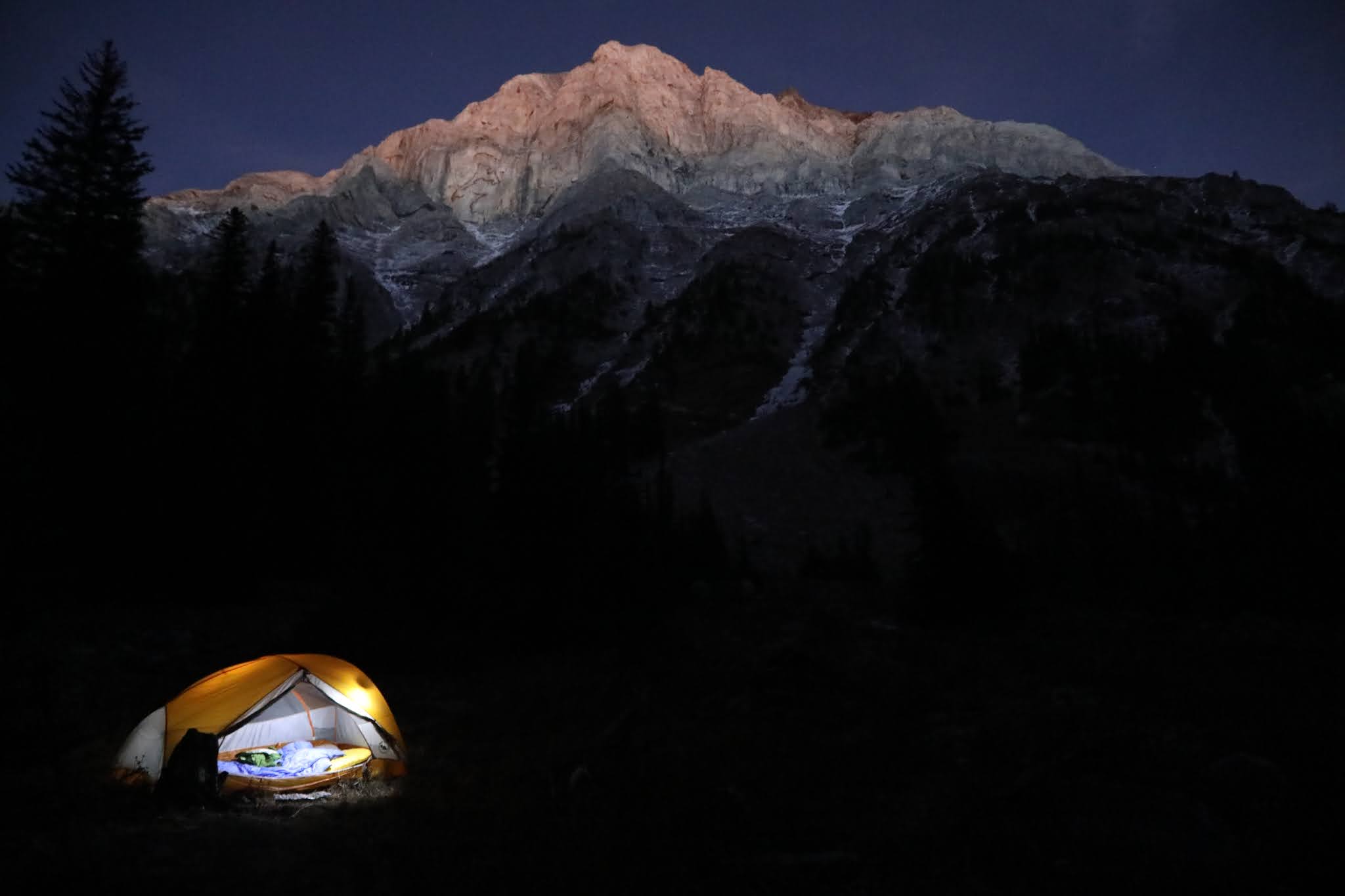
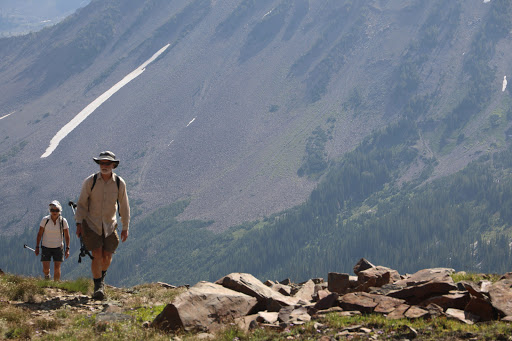
A recent backpack trip into the Wallowa Mountains of northeast Oregon had me thinking about the plant life. It seems that flowers are what most people appreciate about plants, and judging by the number of images, that is definitely the case. Certainly, to properly identify a plant you usually need some floral parts.
A lot can be said about looking at plants without the flowers. So, a slow walk in early October from the Hurricane Creek Trailhead to the nose bleed section of the mountains above Echo and Billy Jones Lake provided an excellent opportunity to look at the plants without their showy flowers.
A notable tree in the high county is the whitebark pine (Pinus albicaulis), a five needle pine that has been impacted over the past forty years with bark beetles and blister rust. Whitebark pine grow at some of the highest elevations, experiencing some of the harshest weather. When you see these trees, it appears they have been through a lot, and they have.
 |
| A sizable whitebark pine growing out of a large chunk of granite. |
 |
| Whitebark pine that looks as if it had been bonsai-ed. |
Looking similar to the whitebark pine, in that it has five needles per cluster, is the limber pine (Pinus flexilis). Naturally occurring limber pines in Oregon are only found in the Wallowa Mountains. One way to tell the difference is to look for cones. Limber pine usually keeps it's cones intact, while the whitebark pine cones disintegrate on the tree.
 |
| A lone cone suggest this is a limber pine. |
A much shorter conifer is the common juniper (Juniperus communis) reaching heights of three feet tall. It's a shrub found throughout Oregon.
 |
| Mat-like common juniper. |
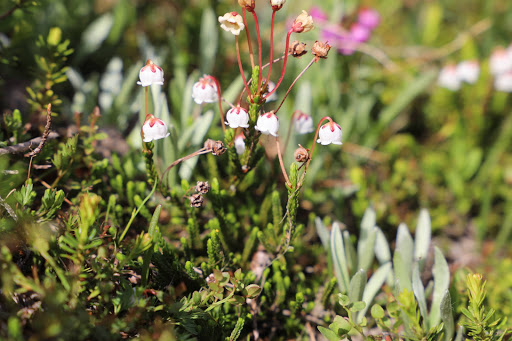
Not all conifers are evergreen, and not all evergreens are conifers. The western larch, a conifer, loses it's needles in the fall, after turning a brilliant yellow, turning whole hillsides into flaming yellow. It was a couple weeks too early to see the colorful larch. But an example of an evergreen that is not a conifer was the pink mountain heather (Phyllodoce empetriformis). In much of the high country this shrub covers vast areas. The flowers are long gone, but the brown seedheads remain.
 |
| As tall as it gets: pink mountain heather. |
A larger shrub that many associate with the western Cascades, but is also found in the hinterlands of the Wallowa and Elkhorn Mountains, is the western Labrador tea (
Rhododendron columbianum). Related to the showy rhododendrons of the mountains, and in peoples yards, this species displays smaller, creamy flowers in the summer, but keeps its foliage throughout the year.
 |
| Western Labrador tea. |
Ferns are an overlooked lot. But down there at your feet, most of the year, are the ferns. American rockbrake (Cryptogramma acrostichoides) appears light green and petite, yet can break a rock, such as this boulder, given enough time. What is the song about the high hopes and the ram thinking he could punch a hole in a dam? This fern, if it has any hope at all, can break a rock!
 |
| American rockbrake. |
Another common fern of the high country is the lace lip fern (Myriopteris gracillima), appearing a darker green than the rockbrake, it is found in rocky areas throughout the North American west.
 |
| Lace lip fern. |
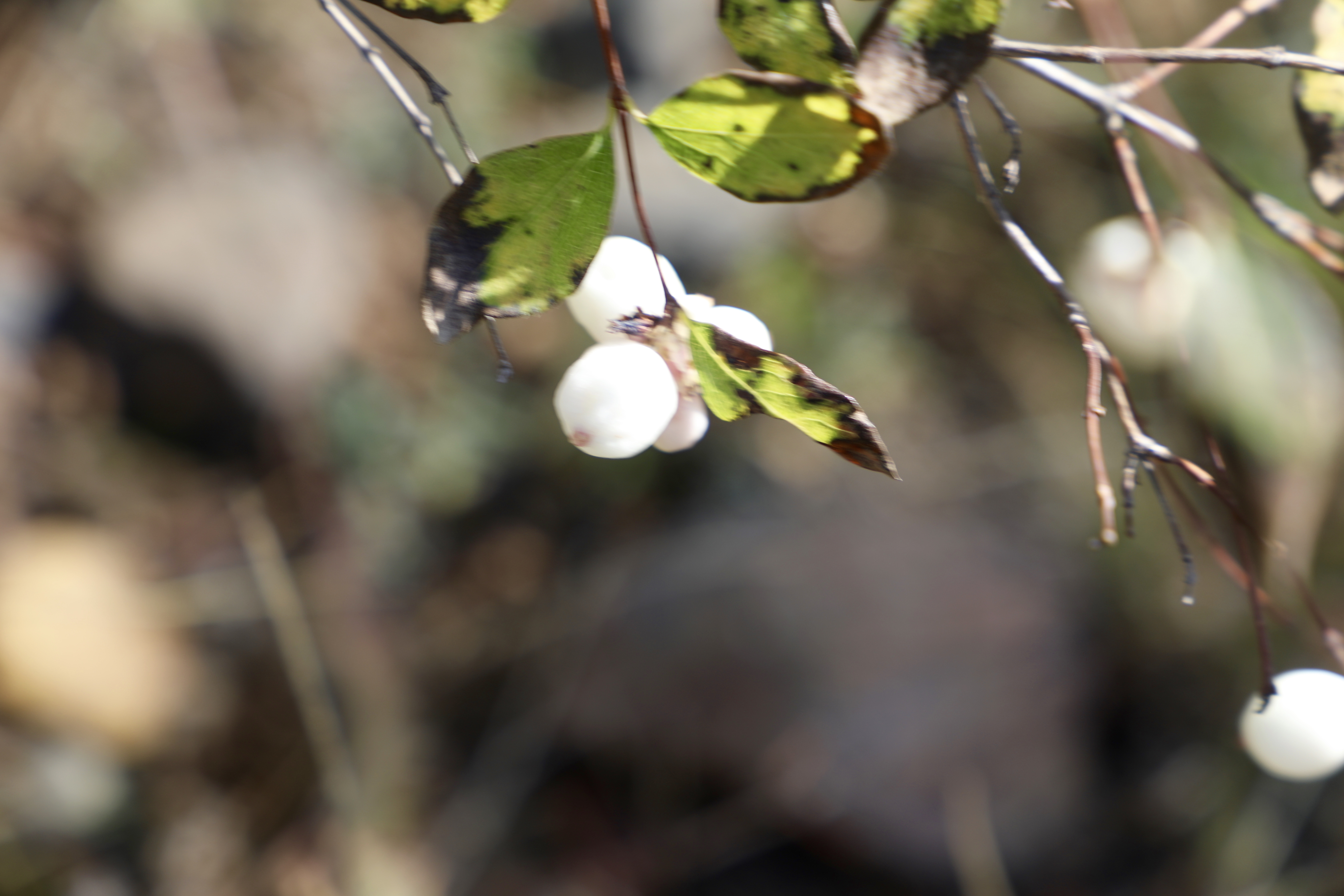
Flowers are long gone on snowberry plants (
Symphoricarpos albus), but the berries will linger into the winter, making this plant easily identifiable.
i |
| Common snowberry |
A plant that is not showy, and frequently stays hidden, occasionally makes an appearance, is the alpine mountain sorrel (
Oxyria digyna). In the buckwheat family the mountain sorrel will display small red flowers on a long stalk in the summer. In protected areas you can stumble across them well after frost has taken out other plants.
 |
| Alpine mountain sorrel. |
After green, yellow and red are two of the prominent colors that plants express during the autumn. Walking through a meadow of dark red and a person recognizes the dying stalks of alpine fleeceflower (Aconogonon phytolaccifolium). It is one of the taller knotweeds, and can be an indicator of disturbance, such as landslides or overgrazing.
 |
| In a high meadow the dark red is alpine fleeceflower. |
Where once were lush fields of gorgeous green sedges (Carex sp.), not too many weeks ago, now the meadows take on a copper hue. Frost, the lack of water, day length, all play a part in the changing colors of the plants.
 |
| Sedge meadow |
Yellows and reds go well together when they occur in nature. The yellow leaves of the aspen (Populus tremuloides) oversee the dark red of the mallow ninebark (Physocarpus malvaceus) with white bark of the aspen providing accent. Aspen are found in thirty-eight states, as well as through Canada, and south to central Mexico. Ninebark has a much smaller range, being found in eight states, as well as British Columbia and Alberta. It never gets tree sized, remaining a shrub forever.
 |
| Aspen and mallow ninebark. |
Not all plants are finished flowering. Arnicas can be an early spring flower, but can also linger into the fall months. At over eight thousand feet above sea level, the clumps of spear leaf arnica (Arnica longifolia) can match the autumn sun for brillance.
 |
| Spear leaf arnica. |
Yellow seems to be the flower color of the season when you also notice the short, happy plants of sticky goldenrod (Solidago simplex). With the demise of the flowers of many plants this time of year, the flowers remaining take on a greater importance for the nectaring insects, the bees, flies, moths, and butterflies.
 |
| Sticky goldenrod. |
Focusing on the flowers that remain in October, is another yellow one: high mountain cinquefoil (Potentilla flabellifolia). It's in the rose family, looks casually like a buttercup, and stays low to the ground to soak up any heat that may be present.
 |
| High mountain cinquefoil. |
Slightly lower on the mountain frost played a role in affecting this cinquefoil plant.
 |
| Frosted cinquefoil. |
Not yellow, and not really a stand-out either by this time of year, is the bluebell-of-Scotland (
Campanula rotundifolia). Earlier in the year they can be a darker purple or blue, but fading as they age. Don't we all?
 |
| Bluebell-of-Scotland. |
White might be the second most common color for a flower. What do you think? A white flower that last well into the snowy season is the pearly everlasting (Anaphalis margaritacea). When does this flower stop flowering and becomes a receptacle for the seed? The flowers appear to last, well, forever. Hence, the common name, and they can be found through the summer, into the fall, and into the winter, poking their heads above the snow.
 |
| Pearly everlasting. |
Not all the plants in this Wilderness Area are native. One classic example of a non-native, or exotic, or alien species, is red clover (Trifolium pratense), which is commonly seen along trails. Evidence that humans brought this species, originally from Eurasia, into the wilds of North America with their livestock. You seldom see this plant very far from a trail.
 |
| Red clover adjacent to the Billy Jones Trail. |
Within the lily family is queen's cup bead lily (
Clintonia uniflora). During the summer the flowers consist of six white tepals (that's a technical term for both the petals, and the sepals, which in this species appear similar). Once the flower is fertilized, and the tepals fall, a blue berry develops at the end of a single flower stem. The common name, and the scientific name, can be looked at for hints as to what this plant may look like--bead lily, and uniflora. So there is one flower/fruit, and it looks like a bead, at least during this time of year.
 |
| Queen's cup bead lily. |
Vascular plants are one thing to look at in the autumn, but other organisms, such as lichens and fungi, are also prevalent in the fall. An example of colorful lichen is the American wolf lichen (Letharia columbiana), usually found on trees, but when they become large enough, or after wind storms, can fall off and be seen on the ground.
 |
| American wolf lichen. |
Mushrooms and other fungi frequently express themselves in the fall. With cooling temperatures and some rainfall the conditions are prime for fungi to present to the world their fruiting bodies. The organisms are nearly always present in the soil in various forms, and when conditions are right, they send out the fruiting bodies that we know as mushrooms. Having very limited knowledge of fungi, I can only surmise that this is an image of a black chanterelle, ebony cap, or black trumpet mushroom. Things I don't know!
 |
| Black fungus along the Billy Jones Trail. |
Walking in the woods, to the high country, in the fall can be an exhilarating experience. The flowers are few, but the plants remain, and in many cases become prettier than when they are in flower. Big huckleberry (
Vaccinium membranaceum) is a prime example of the brilliance and power of the red leaves, compared to the humdrum, innocuous flowers of the summer.
 |
Big huckleberry and Matterhorn Mountain.
|
There is a lot to be seen in the autumn. It doesn't have to be a prominent display of flowers for a person to find attractive. There is a great, big, country just waiting for you to see, no matter the season. Now, close your electronic device, and walk out the door. It's out there for you to explore!